Showing posts with label sensorial. Show all posts

Monday, February 7, 2011

Getting Salty


TODAY'S ACTIVITIES:
  • Cutting
  • Pouring
  • Attribute Blocks
  • Tracing
  • The Phonetic Alphabet

Happy Monday. My son and I enjoyed a quiet weekend at home--well, except for the extremely fun birthday party we attended Saturday night. Our Jeep Cherokee is still away at rehab, so we stayed at the house, homeschooling in the morning and doing "snow day stuff" (those things you do when you're stuck at home) in the afternoons. For nameless reasons, I've been thinking (albeit indirectly) about Schrödinger and his notorious cat; wondering whether by "measuring"--closely observing, photographing and then blogging about--our homeschool sessions, I've been in some way influencing (negatively?) my son's learning. For the sake of sanity, I've chosen not to (try to) definitively answer the question. Instead, I decided that it'd probably be a good thing to periodically let homeschool happen away from the scientist's prying eye. This is all to say that, new computer aside, I won't be blogging everyday, about every single homeschool session. I'm pretty positive you'd get bored (and, oh so much more importantly, I'd get bored) if I did.


OK, having said that, I did put on my scientist's hat this morning. Maybe it's because he's a lefty, but Parker is still having trouble using scissors. (Despite the fact that he did, just this morning, while I was out walking and my husband was upstairs showering, climb onto the kitchen counter, grab a bag of organic quinoa out of the cupboard--the most expensive item he could have chosen, of course--use his scissors to open said bag and then pour oodles of quinoa onto his table so that he'd have a pile to push around with his miniature bulldozer.) Parker has been practicing cutting with some colorful strips of paper printed with various types of lines (straight, slanted, chevrons, curvy) which my sister-in-law (a teacher at a public Montessori school out in Colorado) sent me a while back. He hasn't really warmed to the idea that he should actually keep trying to cut along the lines; instead, he's happy just cutting the strips up willy-nilly. I've recently started reading other homeschooling moms' blogs (see my list to the right there?), and got an idea for an alternative scissor practice activity from Counting Coconuts. (You have to scroll down quite a bit to see the heart strips she made for her son. Do not get me started on how incredibly, insanely intimidating the productivity of this woman is. And she lives on an island, too! So I can't even tell myself, "Well, yeah, it's easy for her because she can go to Target and Michael's and stuff!" But she does have magnificent ideas, many of which I find motivating, so I can't help but appreciate all that she does.) The goody bag Parker received as we were leaving Saturday night's birthday party contained a sheet of little frog stickers, upon seeing which I thought, "Perfect! I will commandeer those for the new Counting Coconuts-inspired scissor activity." I cut up long strips of paper, then placed the stickers on the strips, leaving about a centimeter between each sticker. Instead of having to try to cut along a line, Parker just has to cut between the frogs. He sort of liked it. It seems as though he doesn't feel very confident about his scissor skills (notwithstanding this morning's quinoa episode).


We started work on the phonetic alphabet this morning, an activity I saved for last because it involves placing a pan of salt in front of my son--I just knew he'd be itching to get his miniature bulldozer (and other trucks) into that "sandbox" ASAP. The books tell you to introduce only two letters at a time, choosing letters that both sound different and look different. (In other words, don't present "b" and "d" at the same time.) I used an amalgam of two methods this morning, and it seemed to work well with my son, so I'll continue to do so as we slowly make our way through the alphabet. First, I presented the letter to Parker using a sandpaper letter, saying the sound of the letter and using my finger to trace the shape of the letter in the same way I would write it. I then gave him a turn with the sandpaper letter, asking him to repeat the sound of the letter, and then trace it with his finger the way I'd shown him. After he'd done that for a bit, and was reliably tracing the letter in the right direction, I slid the sandpaper letter aside and placed a cake pan--its bottom covered with table salt--in front of him. I repeated the phonetic sound of the letter, then used my finger to "write" the letter in the salt. I passed the pan to Parker, asking him to say the sound, then "write" the letter in the salt himself.


I was (understandably) both immensely excited and awfully nervous to embark on this letter endeavor today. Our homeschool thus far has been mostly fun; my son has been learning almost accidentally as he's worked with the Montessori materials I've prepared for him. Teaching him the phonetic alphabet seemed to me so much more like "real" instruction. "Will he be even remotely interested?" I asked myself. "Will I have to ceaselessly cajole him to sit down and learn his letters?" (If the answer to that first question had been no, then I'd have put the materials away and tried again in a month or so. At least, I'd like to think I'd have done that.) Well, while my son didn't exactly exude jubilance while learning the letters a and t this morning, he did act attentive and I could tell that he derived some pride from his efforts. Because Parker is left-handed, demonstrating how to trace/write the letters posed a bit of problem for me. In order to properly show him how to do it, I had to trace/write with my own left hand, and it was almost as if I was also learning how to write the letters a and t. I actually finally understood why all those ignorant educators way back when found it easier to just force left-handed children to use their right hands. It probably made teaching writing so much simpler (for the teachers, of course, not for the actual students). The only other (minor) issue I had this morning was the problem of working with salt in a tropical environment. It's just too humid here. The salt kept sticking to Parker's hands, and clumping up. But if that's the biggest hurdle we have to face while working our way through the phonetic alphabet, then I'll count myself lucky.


"I'm ready to just play now."

Parker working with his Aunt Mandi at Ross Montessori School last September.

Friday, February 4, 2011

Sound It Out


TODAY'S ACTIVITIES:
  • Comparing Sounds
  • Bead Stringing
  • Making Patterns
  • Sorting
  • Musical Scales
  • Pouring
I presented two new (and super fun!) sensorial activities to my son this morning. We're approaching the bottom of the sensorial bucket--just a smelling activity and a tasting activity left. It'll soon be time to officially start working on language development. (Reading and writing! Yay!) I say "officially start working" because my son and I have been talking about letters and their sounds for months now. For instance, I'll inquire, "How's your buh-buh-bagel, Parker?" To which he'll reply, "B! Bagel starts with B! My buh-bagel is yummy." (At which point, I'll often say something like, "I'm glad your bagel is yuh-yuh-yummy. What letter makes the 'yuh' sound?" We can go on like that for a while. I'm sure our fellow bakery patrons think we sound pretty sss-sss-silly.) Really early this very morning (and by really early, I mean predawn early), while watching a demolition derby with me on YouTube, Parker saw a front end loader with "GERRRR" painted on its bucket and casually asked, "Mommy, did you see the 'grrrrr' on that loader?" Those nine words definitely made up for having to wake up so wicked early today. Now on to learning how to read actual words (and eventually stories!), in addition to the paint on demo derby vehicles.

For the comparing sounds activity, you need an even number of containers, preferably opaque. (I only had these glass containers, so I wrapped them in paper after I took this picture.) Fill them with various household objects, making pairs, like above; I used rice, macaroni, dried beans, Parker's plastic ball beads and foam shapes (to provide a contrastingly quiet set of shakers).

In this activity, the child matches the shakers that sound the same. The point is to help the child refine his listening skills. Since the shakers all look the same, the child has to concentrate and listen carefully, as well as remember the different sounds as he tries to find their pairs.

After he finished matching all five pairs, I allowed Parker to open the "maracas" (as he called them) so that he could to check his work (and eat some crunchy pasta, of course).

I put away his ball beads a few months ago when he finally tired of bead stringing. He was so excited to see them inside the maracas today! He did some haphazard bead stringing at first, then we practiced making patterns with the beads.

I bought this container at Morrison's School Supplies, thinking it would we'd eventually find a use (or uses) for it. When I saw how much fun Parker was having with the ball beads, I broke out the container, thinking he could use it to do a little sorting.


For the musical scales activity, you need glass bottles and (colored) water. You really only need five bottles (or eight, for a full musical scale), but I wanted to start the activity with just two bottles, one empty and one full, to exemplify the difference between a "high" sound and a "low" sound.

High and low.

Then I added the half-full bottle, to demonstrate an "in-between" sound.

Then I showed Parker how to make a musical scale. He had a turn putting the bottles in order, then I showed him how we can use them to play songs like Mary Had a Little Lamb, Twinkle, Twinkle, Little Star and Frère Jacques.

Then he spent some timing pouring, because Parker loves to pour. (I encouraged him to continue tapping the bottles as he emptied and filled them, to hear the different sounds they made. He sort of did so; mostly he was just happy to pour.)

Thursday, February 3, 2011

Shaping Up


TODAY'S ACTIVITIES:
  • Geometric Insets
  • Matching Two-Dimensional Shapes
  • Basic Land Forms
  • Basic Weather Phenomena
  • Ocean Animals and Their Habitat
We started today's homeschool session by tracing some shapes, which allows Parker to practice using a pencil (thereby helping prepare him for writing). I made the geometric insets out of some brightly colored foam sheets my mom sent us. Parker loved the way they looked and felt; he spent a few minutes taking the shapes out of their frames, feeling their edges, stacking them and lining them up. They ended up being all form, no function, though: the supercool foam just wasn't sturdy enough to trace around. I quickly grabbed the plastic template I'd used to make the insets--which I'd deemed not preferable as a learning tool due to its jumbled appearance--and let Parker use that instead. It worked fine, and Parker had a grand time tracing shapes. After he completed each shape, I had him draw horizontal lines, from left to right, within it (more pencil practice). (The plastic template is from a Learning Resources Attribute Block Set, a very neat and versatile product I look forward to doing more with soon.)

Oops, too flimsy. (The pencil kept slipping under the foam.)

Ah, much better.

After tracing, we moved on to matching two-dimensional shapes. In this activity, the child matches gradated circles (or triangles or squares) to corresponding holes/outlines. I painstakingly prepared the materials for this activity yesterday morning, and I have to reveal that my husband laughed when saw the raggedy, misshapen result. In my defense, I could locate only one compass here on island--a cheap, plastic, ineffectual one. I did my best, but even I had to admit that my efforts didn't amount to much. I needn't have worried, for two reasons: Parker didn't seem to notice any of the apparent defects and he took all of thirty seconds to complete the "white puzzle" (as he called it). This activity must not pose much of a challenge to Parker, so its (imperfect) materials will most likely be retired fairly quickly. Since he did complete the purported activity with such ease this morning, I had to brainstorm up some alternative things to do with the gradated circles. We stacked them from biggest to smallest, then smallest to biggest, then lined them up from biggest to smallest. And then we put them away, because after awhile it's hard for a little boy to resist the urge to turn circular objects into wheels. Or frisbees.

Hmm, I don't think this is quite right.

All done.

While we were in California last October, I spent a couple hours perusing the aisles of Morrison School Supplies. I, of course, wanted to buy at least half of what I found there; if only homeschool supplies were government-subsidized! I allowed myself a (crammed) basketful of educational materials, which I'm slowly but surely presenting to Parker. The Learning Resources Attribute Block Set was in that basket, and so were two sets of Creative Teaching Press photo cards (Our Earth and Understanding Weather). We studied the photo card sets for the first time today. Though (or because?) our own weather can get to be pretty boring (85 and sunny, day after day, for days on end, ho hum), Parker loves talking about snow and rain, wind and fog. He'll announce that it's "freezing cold" outside, and tell me it's time to (pretend to) put on our hats, coats and mittens. So he definitely liked looking at the weather photo set. And we've also been talking about different ecosystems; of course the one in which we live, but also forests, deserts, and the like. The earth forms photo set helped further our previous discussions.

The Ohio inspiration.

In anticipation of our arrival in Ohio last September, my mother-in-law had put the materials for various Montessori activities out on her pink shelves for Parker to work with throughout our stay. He particularly liked the farm animal habitat activity. Using some pieces of felt, miniature farm animals and popsicle sticks, he made a farm, complete with pens for the animals. He had a ball opening the pens to let the animals out so they could drink from the pond and taking the animals out to pasture. Watching him work, I made a mental note to pick up some felt before we returned home. In addition to the farm habitat, I've made a forest animal habitat and an ocean animal habitat. The ocean animal habitat consists of sand, shallow water, coral reefs and deep water. While Parker plays with the assorted sea animals, we talk about who lives where, what they eat and how they defend themselves. Sometimes the ocean animals decide they need to go swim in some real water (read: the bathtub).

Ocean animals at play.

Monday, January 31, 2011

The Rainbow Connection


TODAY'S ACTIVITIES:
  • Matching Two-Dimensional Shapes
  • Color Tablets
  • Graduated Rainbow
  • Fun with Magnets
  • Sorting
One downside to homeschooling? Having "real life" intrude on your child's school time. Our new-to-us Jeep Cherokee (the one that's been continually in and out of the shop since we bought it back in November) started overheating this morning, so I had to deal with that mess before my son and I could start our homeschool session. If he'd been in a traditional, outside-the-home school, our car's cooling system troubles wouldn't necessarily have interfered with his education. The hour or so we spent tracking down our mechanic and then transporting our vehicle to the big gravel lot where he works wasn't a complete waste, though: Parker now knows the word "thermostat," and has a rudimentary grasp on what an auto thermostat is supposed to do. This, in addition to the other words he's learned since we bought our lovely lemon: solenoid, (car) computer, radiator. Once we'd been dropped back home by our mechanic (Parker directed him to our house--a skill I hadn't realized my son had already acquired), we did have a good (if foreshortened) homeschool session. We're still working on sensorial activities, but I've also put some basic math (sorting) and science (magnets) materials out on Parker's school shelves, just to mix things up a bit.

There's a more traditional "matching two-dimensional shapes" Montessori activity, which I will prepare and introduce to my son soon. In the meantime, the mini-puzzles out of the Lauri Toys Primer Pack I bought Parker prior to our last big trip make for pretty good practice working with geometric shapes. He disassembles all four puzzles at once, then puts them back together, piece by piece. There are various-sized circles, ovals, triangles and quadrilaterals, so he has to identify size as well as shape to complete the puzzles.

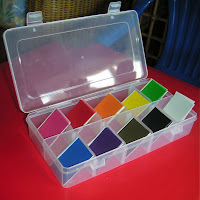
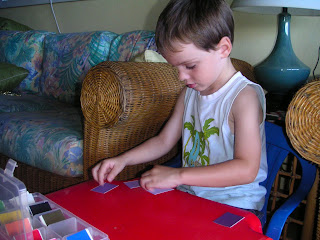
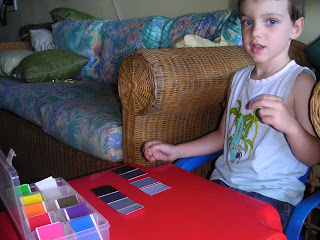
Color tablets are insanely easy to make: you just cut up paint sample strips! In this activity, the child is supposed to grade the shades of one color, i.e. line them up from darkest to lightest. I saved half of each paint sample strip to serve as the control of error; after my son does his best to line up the color tablets in the correct order, he can compare his work to the still intact paint sample strip to see if they match.

Working with shades of purple.

Checking his work.

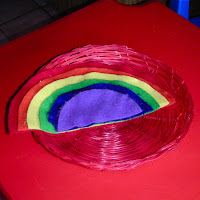
My mother-in-law sent me a box of Montessori goodies a while back, which we've been enjoying. Parker particularly likes an activity called the "graduated rainbow" (I made that name up--I don't know its technical title). It consists of pieces of red, orange, yellow, green, blue and purple felt cut into half-circles, graduated in size. The red half-circle is the largest and the purple half-circle is the smallest, so you end up with a rainbow when you do the activity correctly.

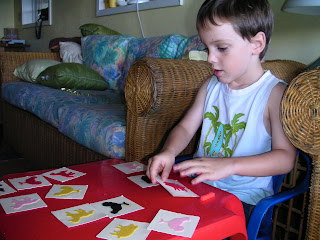
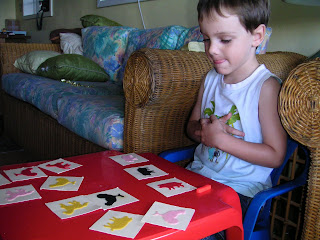
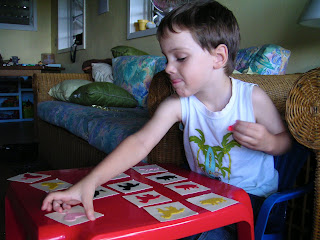
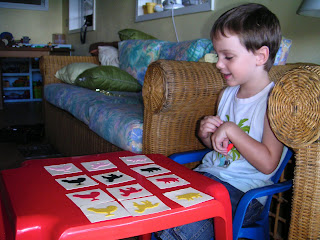
Another treasure from Grandma Betty: farm sorting cards. These are twelve square cards with pictures of horses, roosters and pigs glued on. There's one pink, one red, one yellow and one black horse; one pink, one red, one yellow and one black rooster; and one pink, one red, one yellow and one black pig. Parker can sort the cards either by animal or by color. Today, he lined up the pigs, pink, black, red, yellow. Then he copied that color sequence with the horse cards, placing them above the pigs, and then again with the rooster cards. Then he sat back and realized that he had rows of the same animal and columns of the same color. Cool stuff.


Magnet fun.

Saturday, September 11, 2010

Why I Like Paying Taxes

Grandma Betty took Parker and me to Osborn Metropark this morning. When she told me we'd be going to a park, I was expecting just some big grassy field with a playground attached. Was I ever wrong! Osborn Park is amazing: it's huge, with soccer fields, a beautiful old barn, a dog run, a public garden, a visitors center, a children's forest and the requisite playground. The children's forest astounded me. It's such a resplendent (and educational!) interactive treasure! Hooray for whoever designed it! And hooray for the tax dollars that payed for it!

Thursday, August 26, 2010

A Smörgåsbord, My Kingdom for a Smörgåsbord!

I am a big believer in the Montessori method, and geek out like crazy whenever I "scout ahead" to research all the fun activities my son and I will get to do further down the road in our homeschooling adventure. I had been eagerly anticipating the sensorial chapter of our Montessori-inspired curriculum--who wouldn't want to experiment with textures and scents and colors and temperatures and sounds?--but my son so far has not shared in my enthusiasm. I've thought about this a lot (and worried about it and laughed about it and cried about it and written about it) but all for naught. I'm still not really certain why my son continues to mainly ignore the sensorial activities in favor of transferring rice and pouring water for the (seemingly) thousandth time. I have a some theories, though. He could still be adjusting to the idea of homeschooling (wait, Mommy is my teacher?!?) and its attendant structure; the timing could be wrong (kids learn when they're ready to learn); the myriad distractions of late (DMV stuff, playdates, heat, humidity, his dad's changing work schedule) could be making it difficult for him to concentrate on new concepts. And I have another hypothesis. One that's been nagging at me since we started doing sensorial activities. One that calls into question our very curriculum.

Here's the thing: you can't really homeschool Montessori-style. Not at first, anyway. In traditional Montessori classrooms, all four walls are lined with shelves, each shelf full of materials for myriad activities. There are practical life activities available, and sensorial activities, and language and numerial and geography and science activities. There's usually a reading nook packed with miscellaneous books and often some puzzles as well. The traditional Montessori classroom is a veritable smörgåsbord of educational activities. And (this is key) Montessori students are allowed--nay, encouraged!--to follow their interests; throughout the course of each school day, they choose the activities that most intrigue them. The problem with trying to homeschool in a Montessori sort of way is obvious: I do not have a Montessori classroom (a scholastic smörgåsbord, if you will) contained within my home. Not only that, the books I'm using to guide me in my endeavors (Teach Me to Do It Myself, Teaching Montessori in the Home) advocate presenting the materials in a sequential manner; that is to say, following a set teacher-dictated curriculum (practical life then sensorial then numerial then language, etc.) rather than allowing my child to choose from a wide range of educational activities. Don't get me wrong, my son is still allowed a relatively huge measure of freedom in our homeschool. It's not like I'm sitting across from him with flashcards, saying, "And now we shall practice our letters. Repeat after me." I mean, the kid still hasn't tried folding the washcloths again, three months after his first attempt. And that's fine, it's his choice. But we've been struggling for the past month because he hasn't really wanted to do any of the new (sensorial) activities, and the old (practical life) activities have started to bore him. And I, stubborn, inertial Taurus that I am, have just kept plodding along, dutifully pulling out our school shelves and believing--against ample evidence to the contrary--that my son will suddenly get inspired by sandpaper and fabric and stuff.

Another theory of mine (I call it the scads-of-time-sitting-in-the-baby-carrier theory): Parker's not amazingly excited about our sensorial activities because they feel a little "old hat" to him, and they feel "old hat" because he spent a significant part of the past three years in our Sherpani backpack, like a monkey on my back, as I walked and walked and talked. Allow me to digress for a moment and eulogize the best baby-related product I've ever bought (actually my mom bought it for me, but that's beside the point)... Nevermind, the way I feel about our Sherpani backpack defies description. I'm kind of in denial about the fact that Parker has finally outgrown it. It's still sitting by our front door, next to our shoes, and I'm sure I'll start sobbing uncontrollably when I eventually get around to putting it away. There hasn't been a toy, a book, a crib, a nursing bra or a stuffed animal that has more enhanced my life and my son's life than that backpack. He was nine-months-old when we got it, and for the next almost two-and-a-half years I strapped him in it so that we could take a walk together at least every other day. The thing about a baby carrier backpack (as opposed to a stroller) is that your kid is right there with you, just over your shoulder, seeing (and hearing and smelling and touching) all the same things as you. And, because he's right there, just over your shoulder, you can talk to him. Sure, when we first started out, our conversations were a little one-sided ("Ooh, I see a horse, Parker! A caballo!" Drool drips down my shoulder.), but soon enough we were having grand discussions about everything we were experiencing as we walked around our neighborhood. We talked about (and smelled!) the flowers we passed, we stopped to touch the needles on cacti, we reveled in cool breezes and we mimicked the different traffic sounds we heard. He loved it when I'd purposefully walk under a low-hanging tree branch so that the leaves would brush against his face, and he laughed gleefully whenever I walked along the edge of a trail so that he could reach out and touch tree trunks ("Doesn't the bark feel rough, Parker?"). The aforementioned theory is this: my son was doing sensorial activities pretty much every time we went for a walk together, so the sensorial activities I've recently prepared for school just don't pique his curiosity. He's ready for something new.

One final note: The "something new" is indisputably the alphabet. Parker can't get enough of learning about letters. He spontaneously reaches out to trace letters when we read books together, he asks which letter certain words start with, he walks up to signs he sees around town and identifies the letters he knows. If he were in a traditional Montessori classroom, I'm sure he'd be reaching for the materials to do language activities nine times out of ten. So today, when we were at the beach, we practiced writing letters in the sand, which is similar to a particular Montessori activity. It was fun.

Wednesday, July 28, 2010

Love Your Work


YESTERDAY'S ACTIVITIES:
  • Using Tongs
  • Dusting
  • Transferring
  • Fabric Basket
  • Mystery Bag
  • Pouring
  • Rough and Smooth Boards
  • Graduated Blocks
TODAY'S ACTIVITIES:
  • Bead Stringing
  • Transferring
  • Sweeping
  • Mystery Bag
I listened to this great Radiolab podcast while I was out walking yesterday. The program, in which renowned author Malcolm Gladwell discusses the subject of success with Radiolab host Robert Krulwich, was both thought-provoking and laugh-out-loud funny. (I sometimes wonder how many St. Johnians have concluded that I am certifiable upon observing me guffawing while out walking. I bet they'd be laughing, too, if I could only share my earbuds with them. Wait, Wait... Don't Tell Me!, Car Talk, Fresh Air, Radiolab and This American Life all produce some seriously funny podcasts. I'll never go back to listening to boring old music while exercising again.) Gladwell argued that while talent is good and all, what really ensures success isn't natural ability but intrinsic motivation. In other words, a person has to love what they do--pretty much to the point of fanaticism--and want to keep doing it regardless of whether it yields any kind of measurable return. Gladwell used the examples of Wayne Gretzky (who, as a two-year-old, would burst into tears whenever a hockey game he'd been watching on TV ended), The Beatles (who, before they achieved any measure of success, worked a gig in a strip club in Hamburg, Germany, playing 8-hour sets, 7 days a week, for months at a time) and Bill Gates (who, as a 15-year-old, wrote computer programs in the wee small hours of the morning instead of, you know, sleeping). If he hadn't been so passionate about computer programming (I know it's hard to fathom such an odd passion, but stay with me here) Bill Gates would have turned out to be just some smart guy from Seattle. Probably, because he is very intelligent, he'd have been a fairly wealthy and accomplished smart guy from Seattle, but there are a lot of fairly wealthy and accomplished smart guys in Seattle (not to mention around the world). He's world-famous (and fabulously wealthy, of course) because something inside him just couldn't stop programming; something intrinsic to Bill told him that computer programming was better than sleep, better than food, better than anything else imaginable. And he listened to that inner voice; more to the point, his parents and teachers allowed him to listen to that inner voice.

After I published the previous post (in which I expressed my frustration over my son refusing to do any of the new sensorial activities I'd prepared), it occurred to me that some of you may be wondering why I don't assume more of a traditional "teacher" role during our homeschooling sessions; that is to say, why I don't structure each session according to a premeditated lesson plan. In most American classrooms--from pre-K to college-level--the educator decides what the students will be taught (notice I didn't say what the students will learn), and enforces a strict schedule of lectures and/or activities pertinent to the subject matter. If the student complies with the teacher's lesson plan (sits quietly while the teacher talks, completes the corresponding activities correctly), he/she gets a gold star or an "A"--basically he/she is rewarded. If the student doesn't comply, he/she is deemed ill-behaved or unintelligent or sent to the principal's office or what have you. If the student continually refuses to comply with the teacher's expectations, punishments or parent-teacher conferences or diagnoses of ADHD (or all of the above) ensue. This method of education is entirely focused on the teacher. The student learns that it is the teacher's interests (i.e., lesson plans) that are most important; that compliance ("good behavior") is valued above curiosity, independence, initiative. Any intrinsic motivation the student may have regarding learning is slowly but surely squelched at the hands of a teacher-centric education based upon punishment and reward.

Learning is supposed to be fun, right? But how can it be when the teacher controls everything from what the student learns to how the student behaves (where to sit, when to talk, when to pee)? In Unconditional Parenting, Alfie Kohn (an author who studied and wrote about education long before he started writing about parenting) says, "Students tend not to think as deeply, or to be as interested, if they have little to say about what they're learning or about the circumstances in which they're learning it." Call me crazy, but I don't want to raise a well-behaved child who listens quietly while the teacher talks, who completes worksheets correctly and gets "A"s on all his quizzes. I want to raise a child who is curious about the world around him, who quests after knowledge, who is intrinsically motivated to learn new things. (They're not necessarily mutually exclusive; I wouldn't mind if he ends up being well-behaved and getting "A"s, too, of course.) When we do school each day, I want him to be focused on the activities available to him, and to feel free to approach them with curiosity and independence and initiative. I do NOT want him to be focused on whether or not he's doing what I want him to do, on trying to please me.

I brought up the Radiolab podcast because it seemed salient to the undeniably unconventional way I'm educating my son. Gladwell seemed to be saying that the secret to success is the ability to be intrinsically motivated--to want to do something just because you love it, regardless of any potential external reward (praise, money, et cetera). If I want my son to be successful in school--that is to say, to be successful at learning--I need to allow him to approach it without any external motivating factors. If I'd forced him to do the sensorial activities on Tuesday, he'd have been doing them to make me happy or out of some compulsion to comply with my wishes; in other words, he'd have been externally motivated to do them. The most I can do--the most I should do--as his educator is prepare the appropriate activities, make them available to him during our homeschooling sessions and give him help and/or guidance when he needs it. Like Galileo Galilei said, "You cannot teach a man anything. You can only help him discover it within himself."

Matching Squares
(Fabric Basket)

Postscript: We did end up doing sensorial activities yesterday and today. The fabric basket activity is basically a matching game: using fabrics of various textures (ideally all the same color), you cut two squares of each fabric and then mix them up and put them into a basket. The child has to use his sense of touch to find the matching squares. The mystery bag activity is another tactile one: you collect a variety of small everyday objects, put them on a tray and show them to the child. Then you cover them up with a dish towel, ask the child to close his eyes and put one of the objects into a bag. The child reaches into the bag and uses his sense of touch to try to figure out which object it is. (You can do this one different ways; put all the objects in the bag at the same time and/or neglect to show the child the objects on the tray before you start the activity.)

Small Everyday Objects on a Tray
(Mystery Bag)

The Reveal
(Mystery Bag)

The Crown Royal Bag in Action
(Rough and Smooth Boards)

Wednesday, July 21, 2010

Skyscrapers and Sandpaper


TODAY'S ACTIVITIES:
  • Cutting
  • Graduated Blocks
  • Rough and Smooth Boards
  • Using Tongs
I must have missed the memo about three being the new two. My son chose to skip the "terrible twos"--allowing me to slip into a naively content and unguarded state of mothering--only to dive head first into some sort of "tyrannical threes" phase. He's willful, ornery, domineering and contrary. Quite contrary--if I say up, he says down, if I say sit, he says run, if I say playground, he says beach. It's to such a degree that I'm absolutely certain that if I said, "Let's go play at the beach and then eat lots of cake and ice cream and then go to the store and buy one hundred new toy trucks for you," my son would reply, "STAY HOME!" So I wasn't exactly shocked this morning when he lay down on the couch and stated in his most crotchety voice, "I'm not doing school," after I'd pulled out our school shelves and rung our school bell. I just said, "OK, I'll do school by myself," grabbed the cutting materials and started placidly snipping away. Soon enough, Parker was sitting by my side, patiently awaiting his turn with the scissors.

I've noticed that my son tends to enjoy--and be able to apply himself more patiently and with more focus to--new activities the second or third time he works on them. Maybe this is because the newness of the materials is a distraction to him the first time he handles them, or maybe it's because he needs a school session or two to completely grasp the object of the activity, or maybe it's because I get incredibly, hyperactively excited when I'm presenting a new activity to him and he can't concentrate when his mom is acting like such a geek. Regardless, today proved no different; he had a lot more fun working with the graduated blocks today than he did yesterday, especially once he started stacking them on top of his little table, thereby creating a really tall ("taller than me, Mommy!") "skyscraper." Like my mother-in-law said, preschoolers love repetition, and Parker confirmed that fact by building and dismantling his skyscraper again and again and again (and again and again). I do still struggle with staying silent while my son is working--it was hard not to speak up when I saw him grabbing the wrong block--but obviously there is so much value in sitting back and letting him discover (and remedy!) his errors all on his own.

I introduced the rough and smooth boards activity this morning, which is designed to stimulate tactile awareness and illustrate the textural opposites of rough and smooth. The materials for this activity are three-inch squares of various grades of sandpaper, glued to pieces of cardboard. You make at least six of these "boards," jumble them up and then have your kid sort them according to feel. Parker was already familiar with the terms (rough, smooth), because I often use them to describe things he touches (and, like all little tots, he is absolutely addicted to touching anything and everything): a tree's bark or a marble or his dad's unshaven chin or the glossy cover of a magazine. He liked feeling the sandpaper squares, but he quickly realized that the grey squares were the ones that felt smooth ("flat") while the brown ones were the rough-feeling ones. Like I briefly discussed yesterday, when creating the materials for these sensorial activities, it's important to have everything appear the same except the object of the lesson (in this case, texture). In other words, the sandpaper squares should have all been the same color, shape, size (even smell and taste!); the only thing that differentiated them should have been their texture. I could not find various grades of sandpaper that were all the same color, though. My solution to this was to have my son do the activity while wearing a blindfold after he'd become acquainted with the materials. He would then have to sort the sandpaper squares by touch, not sight. Well, when I rolled up a kitchen towel and told Parker that I was going to tie it around his head so that he wouldn't be able to see anything, he did a pretty good imitation of a donkey digging in his heels. Apparently, he feels very attached to his sense of sight. When I was a little girl, I used to love to tie a bandana across my eyes and stumble around the house blind, so I was a little confused by my son's resistance. But he's never been blindfolded before and I guess the idea can sound a little unnerving if it gets sprung on you out of the blue (like when you're sitting in school with your mom, happily sorting some sandpaper squares). I didn't force it. Instead, I donned the kitchen towel and let my son watch me categorize the squares using my sense of touch. Meanwhile, he used his sense of sight to tell me whether I'd grouped the squares correctly or not.

Postscript: I put out some uncooked penne with the tongs today (usually we do the using tongs activity with cotton balls). Parker ended up putting the tongs down and eating the "crunchy pasta" only a few minutes into the activity. He had refused to eat all morning (did I tell you he's been acting contrary?), so it didn't surprise me. In fact, I switched out the cotton balls with the penne at the start of school because I figured he had to be hungry. Uncooked pasta is better than nothing.