Showing posts with label preschool. Show all posts

Thursday, January 27, 2011

High (Five) Holidays


Every month or so, upon receipt of his latest High Five, my son and I stop everything, sit ourselves down and proceed to plunge into the pages of another enriching issue of this marvelous preschool magazine. To be honest, I wasn't exactly atingle with excitement when my mother emailed me a little over a year ago to say she'd purchased a subscription to High Five for Parker. High Five is published by the people behind Highlights, that magazine perennially found dogeared and discarded inside pediatricians' waiting rooms. Am I the only one who, awaiting another annual checkup, found myself turning yet again to an old Highlights issue in a desperate attempt to alleviate the maddening mixture of boredom and anxiety that every kid feels when they know their turn with the doctor looms ahead? And did that old Highlights issue do anything to either pique my interest or calm my nerves? No. I'd inevitably toss it aside in frustration, incredulous that there were adults out there who actually thought kids would enjoy reading such insipid drivel. (OK, so I might have suffered from a slight case of ennui as a child.) Needless to say, I had very low expectations for Highlights magazine's younger sibling. Well, was I ever wrong! It is chock full of educational stories, poems and projects, from counting activities to hidden picture pages to bilingual stories to zoology lessons to kid-friendly recipes, and more! For my son and me, receiving a new issue of High Five is sort of like having a substitute teacher come teach in our homeschool for the day; the magazine becomes a pseudo lesson plan, one which we follow (mostly) to the letter, out of which we get immense enjoyment. I know that part of the reason we derive such pleasure from our "High Five holidays" is that they only come once a month. If we were to try to implement a High Five-like lesson plan in our homeschool everyday, I'm certain that not only would we both chafe at the confines of such a strict schedule of activities, but also that boredom would abound. One magazine a month is just about perfect for us.

One of the fantastic features of High Five is how every feature highlights (pardon the pun) in some way the current season and coming holiday(s). This not only helps Parker learn to recognize the passage of time (after fall comes winter, then comes spring, then summer, then the cycle starts all over again), but also facilitates discussions about special days (e.g., Thanksgiving, New Year's, etc.). My son and I talk about why the day is special, and what people do to celebrate it. This latest issue (February 2011) highlighted (there's that word again) Valentine's Day, with instructions for a making a "heart mobile." Before we got started crafting our heart mobile, Parker and I talked about why a special day exists just to honor love. (And, no, I didn't tell him it's solely to benefit the Hallmark corporation and jewelry and flower vendors everywhere.) Parker said, "It's nice to show people you love them. Like how I gave the Banana Deck man a hug at the bakery yesterday." I agreed, though I'm not sure we should all start spontaneously forcing unsolicited hugs upon our favorite restaurateurs, no matter how scrumptious their banana shakes are.

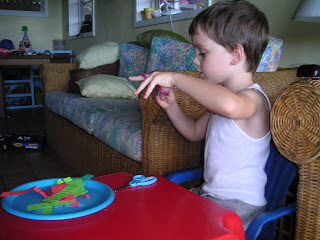
Cutting up bits of paper to use to decorate the hearts.

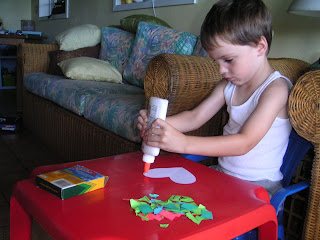
Getting ready to glue some pieces of paper on the first heart.

Adding a little blue crayon to the mix.

Brief break while the hearts dry to talk about letters (the sounds they make) and do some coloring. And make loud, raucous music by playing a pretend xylophone, natch.

Heart mobile.

Tuesday, June 22, 2010

Book Report - Beta Version


TODAY'S ACTIVITIES:
  • Playdate
  • TBD
My son and I had a playdate this morning instead of school. Sometimes you have to be flexible, especially when you (and your kid, of course) haven't seen a particular friend in a while due to scheduling conflicts. We'll take a stab at doing some school this afternoon, post-nap. I'm not sure how successful this will prove, but it's worth a try.

So I'm halfway through Alfie Kohn's Unconditional Parenting, and so far I've found it life-changing. Pretty dramatic description, I know, but true nonetheless. I'm not a big parenting book reader; I tend to rely more on instinct and reflection than advice from "experts." I have friends who are always talking to me (sometimes at me) about the latest and greatest book on disciplining your kid or sleep-training your kid or understanding your kid or training your kid to jump through hoops, and I've even gone so far as to purchase a few of these "You have to read this!" parenting books. The thing is, though, that despite my best intentions, I never really read them. I begin reading them, of course, but invariably find the writing too prescriptive--do this, don't do that. I live in the realm of "shoulds" enough as it is; I'm always telling myself I should eat this and I shouldn't eat that and I should get more exercise and I shouldn't yell at the cat and I should be more patient and I should call my grandmother and I shouldn't watch anymore Real Housewives on TV. I don't need a parenting book telling me what I should do every time my kid loses his temper and shouts at me or my husband. The author doesn't know me or my kid or what led up to the shouting incident in question; how can he or she say for sure how I should respond? Kohn offers a more descriptive technique, discussing in detail the predominant approach to parenting and questioning not only its effectiveness but its long-term effect on our kids. I've got to tell you, even if he didn't cite a ton of studies that back up what he says, I'd agree with Kohn just based upon his use of logic.

Kohn begins the book asking you to describe what type of person you'd like your child to be as an adult. Almost all of us would use the same descriptors: happy, fulfilled, responsible, confident, thoughtful, independent, kind. Then he says to ask yourself, "Are my everyday practices likely to help my child grow into the kind of person I'd like him to be?" When interacting with our kids--especially when they're small--the majority of us focus almost entirely on their behavior. It's all about what they're eating, how much they're sleeping, to what degree they know their colors and numbers and ABCs, whether they're playing nicely with their friends, whether they've picked up their toys, whether they're getting in our way as we try to accomplish things throughout the day. And when we deem their behavior inappropriate or, even worse, bad, we create consequences: we give our kids time-outs or shout at them or withdraw our love and affection for a while. In short, we make our kids feel bad--we punish them--in order to try to control their behavior, usually without ever considering the causes of our kids' inappropriate actions. Kohn's argument is that all this attention we place on our kids' behavior and all the energy we expend trying to control our kids' behavior does not in any way conform to what we assert to be our long-term goals as parents. Do we want them to learn to mindlessly obey authority figures, to only do things (or not do things) out of a fear of punishment? Do we want to teach them that their motives and emotions don't matter, that The Rules must be obeyed... or else? Regardless, Kohn cites a ton of research that shows that punishment doesn't work in the long run. Not only that, rewards (what people sometimes call "positive reinforcement") don't work either. (And remember, praise is just a form of reward!) Look at it this way: most parents have come to accept that the "you must clean your plate" approach to mealtimes is outdated and harmful. Kids need to learn to listen to their bodies, to regulate their own appetites by means of natural feelings of hunger and satiation. Children whose parents control their eating often end up with weight problems and/or eating disorders. Well, the same applies to kids' behavior: if we become dictators, constantly controlling our kids' actions via threats of punishment and/or promises of reward, they never learn to regulate themselves, they never develop their own sense of motivation, of morals, of responsibility. Even worse, independence and initiative is, in a word, stifled.

There's more to this, obviously. I can't sum up everything Kohn says. The one caveat to it all is that you've got to believe your kid is basically good-natured--that kids wouldn't always act badly if they thought they could away with it, that there's almost always a rational explanation for why your kid misbehaved. Maybe they were uncomfortable--physically or psychologically, maybe they were tired or hungry, maybe we were expecting too much from them, given their age. When you enter the kitchen and see a tub of yogurt spilled all over the floor, of course you're going to get upset. But why take it out on your child? He was most likely hungry and trying to get himself something to eat; maybe you were unavailable--in the shower or on the phone--so he thought he'd help himself, instead of interrupting you. Kids' motives are almost always innocuous. I get frustrated when Parker occasionally refuses to pick up his toys; I finally stopped to think about those times he does refuse and it's always when the mess is a big one, with lots of bits and pieces (like LEGOs or Matchbox cars spilled all over, everywhere). It dawned on me that he feels overwhelmed when the mess appears massive. Why wouldn't he? Usually, if I offer to help clean up, he gets moving and the toys are put away in a flash. If I stand there, unyielding, nothing productive occurs, and bad feelings on both our parts become inevitable. The important thing is to never give your child reason to doubt your love. "How we feel about our kids isn't as important as how they experience those feelings and how they regard the way we treat them." Is getting your kid to do exactly as he's told really worth sacrificing his apprehension of your love? If you really do love him unconditionally--even when he has a tantrum or makes a mess or won't let you brush his teeth--then treat him that way.

The second half of the book suggests ways you can guide (not control!) your child's actions--because of course there are times you need to--without using punishments or rewards, without sending the message that your love is conditional upon good behavior. Should be interesting...

Postscript: Kohn also addresses motivation; how we use/abuse rewards (including praise!) in our attempts to encourage our children to "succeed." Basically, the same holds true: by doing so, we're stifling our kids' abilities to motivate themselves and making them feel as though our love is conditional upon them doing well. Extrinsic motivation imposes our own ambitions upon our kids and stifles their instinctual sense of initiative.
Wednesday, June 16, 2010

Tattle Prattle


TODAY'S ACTIVITIES:
  • Hardware Busy Board
  • Dusting
  • Bead Stringing
  • Transferring
  • Sweeping
My son and I skipped school yesterday and participated in an impromptu playgroup instead. (This served as a sort of raincheck for last Friday's cancelled playgroup.) Both Parker and I had a pleasant time, he sharing his friends' trucks, me gabbing with the other moms. At the end of the morning, though, I found myself thinking about tattling, pretty much for the first time ever. An extreme prejudice against tattletales exists in our culture. I grew up indoctrinated to believe tattling to be the worst crime you could commit as a school kid. Name-calling? Not nice. Spitting? Gross. Kicking? Mean. Hitting? Hurtful (literally). But tattling? Man oh man, if you were unfortunate enough to get caught tattling, the best you could do was just pick up stakes and transfer to another school. Known tattletales faced a certain destiny of cold shoulders and even colder disdain. And that from the other kids. The teachers seemed to possess even less tolerance for tattling than their charges, turning a deaf ear to any child who so much as hinted at telling on another. Having started school at an extremely early age, I cottoned on to this quick and never let hurt feelings or bodily injury entice me into tattling. As an adult, I've often experienced a gut reaction of disgust upon encountering tattletales, both young and old. It suddenly occurs to me--and it kind of scares me--that I've never really examined this prejudice I instinctually possess. I'm normally not one to go along with an accepted ideology just because it's, well, accepted. So, about this terror of tattling...

The subject comes up because my son approached me a couple of times yesterday morning to say that his friend did this or his friend did that. My initial (unexpressed) reaction was one of irritation; having no desire to abide his tattling, I wanted to tell Parker to deal with the situation himself. When interacting with my son, though, I have started to use a time-delay system, sort of like the FCC's broadcast delay that's meant to catch celebrities' curse words. I don't curse, but my initial response to my son can sometimes be reactionary and self-centered. A ten-second delay is usually enough of a pause for me to remember to take myself out of the equation, so that I can actually listen to my son without a "but how is this going to affect ME?!" bias. Once I could hear Parker objectively, I realized that he wasn't so much tattling as asking me, his parent/teacher, for guidance. If he could have been more eloquent, he would have said, "My friend did such and such. Is this OK? If it's not OK, how should I respond?" I'm 33, and I still at times have social interactions that cause me to ask those questions. Existing within a society can be tricky, especially since we're not always on our best behavior. Preschoolers have notoriously little impulse control, possess a tenuous (at best) grasp of morality and have only just begun to figure out the codes of civility. We should expect them to have a hard time playing nice with their friends, and we should also expect to have to exert some energy ourselves when certain situations arise. One of our most important jobs as parents and educators is to provide young children with a moral framework that will serve them for the rest of their lives. When our kids come up to us and say, "So-and-so did this," they aren't tattling; they're providing us with teaching opportunities. I'm not saying that we should stand up and intervene; angrily shouting, "Hey, Johnny! Stop throwing sand at my kid!" won't teach anybody anything. We should sit down and explain, instead, giving our children the guidance they're seeking. When a child tattles, he's looking for confirmation that something that happened is or isn't OK, and he's asking for help formulating an appropriate response. It's not as easy as waving a dismissing hand and saying, "Work it out between yourselves," but I think it's the more considered course of action.

Thursday, June 3, 2010

"I Don't Like School!"


TODAY'S ACTIVITIES
  • "Threading" Toothpicks
  • Pouring
  • Bottles and Tops
So I know I recently sort of disparaged the "live slow" mentality that prevails among the islanders here on St. John, but there is something to be said for taking your eyes off the prize and getting out of the fast lane. (Eek! Sorry for that mixed metaphor. Hopefully you get the gist.) When I've undertaken a new project, I, like most Americans, have a hard time not fixating on achieving The Goal as quickly and efficiently as possible. I can "enjoy the journey" with the best of them when there's nothing really at stake, but when I'm trying to accomplish something I'd rather fast forward through said journey and then sit back and behold the fruits of my labor. Well, The Goal in question here is of course the education of my child, and I can now say with no measure of uncertainty that I am sure to go insane if I don't start loving me some scenery. We've just embarked on an odyssey and Penelope is still a long ways away.

As you can guess from today's title, school was a bit of a struggle today. My son, probably like pretty much every other rookie preschooler on the face of the planet, spent some time testing the pliability of the newly established rules of school. There are really only three new maxims that I've asked Parker to assimilate for the purpose of our homeschool. My husband and I have been hammering home--excuse me, gentling reminding our son of--the other, more standard strictures (no hitting, no screaming, no throwing or climbing indoors, say please and thank you, blah blah blah) basically since he was born. The new rules for school are: (1) all school materials stay on the shelves except those that pertain to the activity in progress, (2) Parker is responsible for taking the materials to his work space and then returning them when the activity is completed, and (3) each school activity must be completed before the materials are returned to their spot on the shelves. I have to say, these "new rules" should have seemed at least a little familiar to my son. We have been loosely enforcing the "put your toy away when you're finished playing with it before you take out a different toy" edict at home for a while now, to a certain extent because I knew it echoed the Montessori behavioral guidelines. And yesterday and the day before, Parker was still content to defer to my suggestions (e.g., "Want to put those toothpicks back in their container?") since the whole homeschool enterprise was so novel to him. Well, not today.

We started out auspiciously enough this morning. As it was nearing time for school, I told Parker, "Hey, bub, in ten minutes it'll be school time, OK?" He looked up from playing with a couple of his trucks and said, "Oooh! I'm going to do the toothpicks first! And then I'm going to do some more pouring!" I pulled out the shelves, made sure everything was ready and then let Parker ring the bell. He did indeed begin with the toothpicks, and was having a grand time, explaining to me that Baby Toothpick was going to join Mommy and Daddy Toothpick in the glass jar. After a bit, though, he accidentally spilled a bunch of toothpicks. At this point (and without picking any of them up) he stated, "I'm going to do pouring now," and got up to get the pouring materials. I removed my figurative muzzle and calmly reminded him that the toothpicks need to be put away before he can get out the pitcher, cup and sponge. Stubbornness ensued, and eventually he moaned, "I'm too tired to clean up the toothpicks," and lay down first on the floor, then on the couch and finally on his bed. Now, I'm sitting there, completely conflicted. Do I transform into
Taskmaster Mommy, haul him out of his bed and stand there sternly, arms akimbo, while he dutifully puts away the toothpicks? Or do I say to myself, "Abort!" and cancel school for the day, lest my son associate negative feelings with homeschool and me? (Hainstock even includes a paragraph in "Teaching Montessori in the Home" about how school should "stop immediately" if it suddenly becomes "a chore.") In the end, I chose the path of nonresistance; which is to say, I stayed where I was, sitting on the floor, and waited until Parker came out of his room and rejoined me. (OK, I did get up to take a picture of the spilt toothpicks. I couldn't resist.) He picked up the toothpicks and performed the activity for several minutes more.

I'd like to say that everything was peachy after that, but school remained a struggle for both of us today. Parker would appear eager to start an activity, apply himself for about five minutes (and well--he'd definitely progressed from yesterday), then jump up and over to the shelves, neglecting to replace the materials he'd been working with. We butted heads. I explained to him that school has special rules (namely, we put things away) and at some point the inevitable happened; he shouted, "I don't like school!" My feelings were hurt, but at the same time a little voice in my head calmed me down by reminding me that every kid says those words some time, some kids ad nauseum. I didn't draw out the school session but, with life skills like perseverance and follow-through in mind, didn't cut it short either, and afterwards sat my son on my lap and tried to talk with him about how school had been a struggle for both of us. I restated my love for him as well as my excitement about starting school with him... And then he began playing with some cars and I began repeating my new mantra to myself, "Enjoy the journey."

(Another casualty of school. All in the name of learning, right?)

Thursday, May 27, 2010

Ding!

The time has come. Over the past month or so, I have espied my son experiencing occasional moments of (gasp!) boredom. Plopped down on the couch, he gazes across the room at one toy then another, and then sighs and turns to stare out the window. This instead of joyfully hopping off the couch and grabbing a car or a puzzle or a stuffed animal (or what have you) and becoming engrossed in play. I know why this has been happening; I know, too, that in those instances when my son is bored I, the stay-at-home-mom, am not doing my job. My son recently turned 3, and though it may seem strange to compare my child to a mass market frozen turkey, the metaphorical pop-up timer in his brain just, well, popped up. He wants more, he needs more: more to absorb, more to discover, more to practice, more to master. Though he is still learning as we move through the course of our days together--playing, reading, walking, shopping, cooking, cleaning--he is no longer as stimulated by the "everyday" as he was when he was younger. And though life often surprises us with unexpected joys to study (like the tadpoles in the rain puddle we've been monitoring), I cannot rely on those surprises to complete my preschooler's education.

So, time to erect some framework in support of Parker's learning. Time to formalize his education. In other words, time for school. I have chosen to homeschool (at least for now), and I have chosen to use primarily Montessori methods. In addition, I have chosen to share my adventures in homeschooling via this blog. My goals in this endeavor are to instill in my son a sense of discovery and awareness, as well as to engender in him a sense of independence and initiative. Grandiose and abstract, I know. It's all well and good to want to raise a lifelong learner, someone who approaches life with curiosity and wonder, but good intentions don't amount to much without a good plan of attack. In light of this, I have been reading the books you see listed in the bibliography at the right and I will continue to refer to them for inspiration and instruction over the course of this venture.

Unsurprisingly, "some assembly is required" not only for many of the activities detailed in the books at right but even for the very establishment of our homeschool. The school will need a set of shelves, some trays and baskets, a child-sized table and a child-sized chair. To create the materials needed for the first few weeks' activities, we will also need sandpaper, cardboard, fabric, clothespins, buttons, beads, a miniature pitcher, miniature tea cups, miniature tongs and more. Acquiring these items wouldn't pose much of a problem if we lived in the States, but they will be almost certainly impossible to find on St. John. But St. Thomas is a ferry ride away and relatively awash with big stores such as K-mart and Home Depot, so my husband and I made plans to take a family shopping trip to St. Thomas together on Saturday. I just checked the weather forecast, however, and on Saturday it is supposed to be soggy, and neither ferryboats nor St. Thomas roads are much fun in tropical downpours. So we shall see whether we will be able to shop 'til we drop this weekend. I know that I can start school without all the bells and whistles, but I was getting so excited about setting up shop and putting all the materials together. Props matter.