Showing posts with label initiative. Show all posts

Sunday, March 13, 2011

Moonstruck


Man, I am LOVING homeschooling a four-year-old! No offense to my son, who only recently graduated from the Tyrannical Threes (as I so affectionately called them), but I am so very thankful that his little self has now orbited the sun four entire times. Four definitely equals fun. There was a troubling time last summer when the strength of my desire to homeschool my son began to ebb. Day after day after day of pouring rice and stringing beads and dusting surfaces had dulled my enthusiasm. I knew the practical life activities my son was practicing were providing him with a strong sense of self-sufficiency (as well as introducing him to the structure and routine of our homeschool). I knew also that preschoolers crave repetition; that they acquire new skills by performing routine tasks ad nauseum. I knew all this and still I could not help feeling mind-numbingly bored during our homeschool sessions. Well, it's a new dawn, it's a new day and I'm feeling good. All of a sudden (sort of), my son is no longer a short-attention-span-possessing, emotionally-unstable, instant-gratification-seeking toddler. All of sudden (sort of), he is a little boy, curious about the world, passionate about animals and space (and also vehicles, of course), willing to concentrate, able to stay calm (mostly), capable of discussing various cool and awe-inspiring topics with me. Seriously: new dawn, new day.


So we've been having an absolute ball in our homeschool (and outside of it as well). We've been learning about animals--having these great, fun talks about myriad species (a lot of said talks edifying not only to my son but also to me). We've been spelling words using the movable alphabet. We've been having fun with geometry with the Magna-Tiles I wrote about in my last post. And we've been discussing space a lot. Parker is fascinated by space right now. He loves learning about the planets; he loves creating rockets and flying them to the moon; he's half-terrified, half-enthralled by the fact that meteors exist. It warms my heart, seeing my son so in love with learning. All I want to do is foster that love, to nurture it and help it grow. In light of that, I recently visited the National Geographic Store's website, expecting to only browse around, possibly purchase one or two educational books about the solar system or animals. (Brief aside: I read a while back that boys--even little boys--usually prefer to read nonfiction; that storybooks don't do it for them as much as informative, fact-packed texts. At the time, I thought to myself, "Yeah, right. Why do people insist on stereotyping our children based on so-called gender-based characteristics?" About a nanosecond after I thought that, Parker started pulling out only his nonfiction books at story time, and continues to do so. I, being female, would love to read scads of magical storybooks with my child; Parker prefers his Usborne flap books.) Anyway, it's a good thing I can comfort myself with the nonprofit mission of the National Geographic Society, because I spent a chunk of change buying books from their online store. There were just so many cool kids' books! (And I could seriously use a break from reading Parker's flap books.) Our new books arrived last week, and we've been reading Moon from the "Jump into Science" series repeatedly. It's a neat little book, with cute illustrations and fun facts about the moon. The author clearly explains why the moon goes through phases, why it looks like it's the same size as the sun (but is really not), that the moon orbits the earth, how the craters on the moon are created and that the moon reflects the sun's light (rather than creating light of its own).


I really like National Geographic Kids' "Jump into Science" series; each book has a "bonus" experiment at the end. Moon's experiment is "Making Craters." You pour about an inch of flour into a cake pan, then find five rocks of various sizes. After explaining to your child that the flour is the moon and the rocks are meteors, you have the child drop the rocks into the flour from about two feet above the pan. (Parker REALLY liked exclaiming, "Here comes a meteor!" every time he dropped a rock.) Then you talk about what happened; how the flour flew out of the way when a rock hit it, creating a crater; how big rocks made big craters and little rocks made little craters. In the book, the author explains that the earth's air protects us from most meteors by causing them to burn up, so I made sure to remind Parker of that fact while he was making meteors crash onto the "airless" moon. Of course, Parker wanted to repeat this experiment over and over and over, which was fine. It wasn't super fun cleaning up the spilled "moon dust," but I'm fine sacrificing a little elbow grease for the sake of science.


Postscript: The next day in school, we did another moon experiment. We brought a small mirror and a flashlight into "outer space" (the darkest room in the house, Parker's bedroom). I held the mirror while standing about five feet from Parker, with the flashlight propped on a table in a corner of the room. First, with the flashlight turned off, I asked Parker if he could see the "moon" (aka the mirror). The I turned on the flashlight, pointed it away from the mirror and again asked Parker if he could see the moon. Then I moved the mirror so that the flashlight shone on it and the light reflected onto Parker. He said, "I see it! And it's bright!" I explained that the flashlight was the sun, the mirror was the moon and he was the earth. Fun stuff.


First of many craters.
"Here comes a meteor!"
Collecting moon dust and meteors.
Sifting the moon dust from the meteors so that he could repeat the experiment.

Thursday, March 3, 2011

Spoils of Birthdays


Though I have been lax in my blogging, my son and have been hard at work in our homeschool, writing letters in salt, spelling words using our movable alphabet, studying the solar system and learning about tropical animals (like manatees) and seabirds (like gannets and turnstones). In addition to all this, before my very eyes, my son has transformed into Super Geometry Boy, fiendishly building two- and three-dimensional shapes out of the Magna-Tiles he received for his birthday. (Thank you, K, Dad, Dec and Keira!) My husband, a geometry nut himself (Super Geometry Dad?), has wholeheartedly encouraged our son's newest passion, teaching Parker about isosceles and equilateral triangles and even building whimsical structures out of the Magna-Tiles all by himself, late at night when Parker and I are both asleep. We've talked about how two isosceles triangles form a square, how six squares form a cube, how six equilateral triangles form a hexagon and how it's possible to build three-sided and four-sided pyramids. Parker is so jazzed about his ability to make squares out of triangles that he has literally spent hours building cubes out of isosceles triangles (first making six squares, then putting them together to form a cube). I like the Magna-Tiles because they present Parker with just the right amount of a challenge: they're not super easy to assemble, but they're also not frustratingly hard. He has to concentrate and use both his motor control skills and geometry knowledge to build his structures. It's super fun to see him so engrossed.

Of course, the structures that Parker builds using the Magna-Tiles almost always have to possess a final cause. He's built garages for his cars, houses, space shuttles, and space objects (in addition to other unrecognizable-by-me stuff). Here are some photos.


Dual-purpose structure: garage and helipad.

Mommy pyramid and baby pyramid.

Pyramid playpen? Pyramid in jail?

The tallest spaceship in the world.

OK, who's seen Wallace & Gromit's A Grand Day Out? Here is the robot skier exiting the space shuttle. (Parker built a hexagon to serve as the moon.)

Friday, February 18, 2011

Going Mobile


I used to long for a room of my own. You know, like Ms. Woolf wrote about, almost one hundred years ago. Lately, I've realized that that dream is totally unattainable (for the foreseeable future, at least). Now, I'd really just settle for a desk of my own. Ooh, no! For a secretary! A secretary of my own! And I'm not talking about a human assistant. No, I'm talking about a super functional piece of furniture in which I could store sundry supplies; one that would boost my productivity and help me stay organized. My mom has a beautiful old secretary--she's had it since I can remember--the nooks and crannies of which I used to love to explore as a small child. A secretary would be perfect for me! Its footprint is small, but its storage capacity is well nigh boundless. And I could use it as a desk! A desk! Oh, what I would give to own a desk again...

I've been fantasizing about office furniture (never mind an actual office!) of late because it's gets a little difficult at times to prepare our homeschool materials sitting on the floor or on our couch. And I've hollowed out a shelf here and the corner of a closet there in which I can store some homeschool stuff, but certain things--like books, my laptop, projects in progress--need to be kept on hand. I'm far too lazy to be continuously pulling stuff out of storage and then stowing it again just a little while later. The layout of our apartment here is a little funky; the kitchen is tiny and the second bedroom is more like a loft, but the bathrooms have a ton of counter space. I'd never really found a use for all that square footage of blue formica before I started homeschooling my son. (If I "put my face on" each morning like some women do, the counters would for sure be laden with foundations and eyeshadows and lipsticks and such. As it is, I've been feeling proud of myself lately because I haven't been forgetting to coat my freckly face in sunscreen everyday.) Now I just stash half-finished projects on the bathroom counters whenever I need to stop sewing or cutting or gluing and start cooking or cleaning or racing Hot Wheels cars around what used to be our kitchen table (before it became Parker's play table). I even keep our new printer on the counter in the upstairs bathroom. There's really no other horizontal surface upon which to place it.

Teachers often half-think about their to-do lists throughout the day; the lesson plans they need to write, the materials they need to prepare for upcoming classes. For the past several weeks, at random moments, I've found myself worrying about a movable alphabet, a crucial component of Montessori classrooms which students use to analyze and form words as they prepare to read and write. I've had some measure of success fabricating homemade Montessori materials, but I knew that creating a functional movable alphabet here at home would be beyond my abilities (or at least beyond my recent energy levels). I could order one, of course, but we've just spent a bundle on fixing cars, buying a laptop and a printer and purchasing Christmas and birthday presents. Our bank account could use a break from debits. I kept thinking about this "Read and Spell" letter game my mom purchased for Parker a year ago. It comes with 86 letter cards, at least two of each letter, the vowels in red and the consonants in blue (including one red, vowel y, and one blue, consonant y). Perfect. The only problem is that the letter cards are all jumbled up in a little box. (Parker could never stand to play the "Read and Spell" letter game for very long because he'd get frustrated trying to find the letters he was looking for.) Movable alphabets should be neatly displayed in a divided box, copies of the same letter placed together, so that the child can easily see (and find) all twenty-six letters of the alphabet. OK, so I had the letters for our movable alphabet, but where would I find a divided box, with at least 26 2"x2" compartments? I searched all over Amazon--craft boxes, tackle boxes, tool boxes, ornament boxes--and even ordered something that I thought might do the trick, but when it arrived the compartments turned out to be too small. Vendors don't describe their products very assiduously, I've discovered. Finally, while we were shopping on St. Thomas last week, I found an almost perfect divided container at Home Depot. It only has 24 compartments, but beggars can't be choosers, right?

Anyway, our new movable alphabet has been sitting around on the bathroom counter upstairs, waiting for me to decide that it's the appropriate time to present it to Parker. I figured he should get through more (if not all) of the phonetic alphabet before he starts to work with the movable alphabet. Probably I should have actually put it away somewhere--and I meant to, I did--because Parker happened upon it and seemed to be totally taken with it. The thing about it being in the bathroom, though, is that Parker kept wanting to work with it right when I was either on my in or on my way out of the shower. Wanting to spell "stupendous" is all fine and good, but I'd rather not help my son sound out a ten-letter word while half-naked. Because of this, I brought the movable alphabet downstairs yesterday morning. I left it on the downstairs bathroom counter, meaning to find a place (more like create a place) to store it, then got distracted and, of course, forgot all about it. I came inside, just before lunchtime, having been working outside, cleaning our deck, then vacuuming out our Jeep, to find Parker spelling "exit" with his pants down around his ankles. Apparently, he'd gone pee and then, seeing the movable alphabet, been so overcome by the urge to spell a word that he couldn't be bothered to pull up his pants. (I pulled up his pants for him, then snapped the below photos.)

"I'm spelling the word exit Mommy!"

Now the last letter.

Exit!

Postscript: The sky yesterday morning was breathtaking. Here are a couple photos I took in between sips of coffee.


Wednesday, July 28, 2010

Love Your Work


YESTERDAY'S ACTIVITIES:
  • Using Tongs
  • Dusting
  • Transferring
  • Fabric Basket
  • Mystery Bag
  • Pouring
  • Rough and Smooth Boards
  • Graduated Blocks
TODAY'S ACTIVITIES:
  • Bead Stringing
  • Transferring
  • Sweeping
  • Mystery Bag
I listened to this great Radiolab podcast while I was out walking yesterday. The program, in which renowned author Malcolm Gladwell discusses the subject of success with Radiolab host Robert Krulwich, was both thought-provoking and laugh-out-loud funny. (I sometimes wonder how many St. Johnians have concluded that I am certifiable upon observing me guffawing while out walking. I bet they'd be laughing, too, if I could only share my earbuds with them. Wait, Wait... Don't Tell Me!, Car Talk, Fresh Air, Radiolab and This American Life all produce some seriously funny podcasts. I'll never go back to listening to boring old music while exercising again.) Gladwell argued that while talent is good and all, what really ensures success isn't natural ability but intrinsic motivation. In other words, a person has to love what they do--pretty much to the point of fanaticism--and want to keep doing it regardless of whether it yields any kind of measurable return. Gladwell used the examples of Wayne Gretzky (who, as a two-year-old, would burst into tears whenever a hockey game he'd been watching on TV ended), The Beatles (who, before they achieved any measure of success, worked a gig in a strip club in Hamburg, Germany, playing 8-hour sets, 7 days a week, for months at a time) and Bill Gates (who, as a 15-year-old, wrote computer programs in the wee small hours of the morning instead of, you know, sleeping). If he hadn't been so passionate about computer programming (I know it's hard to fathom such an odd passion, but stay with me here) Bill Gates would have turned out to be just some smart guy from Seattle. Probably, because he is very intelligent, he'd have been a fairly wealthy and accomplished smart guy from Seattle, but there are a lot of fairly wealthy and accomplished smart guys in Seattle (not to mention around the world). He's world-famous (and fabulously wealthy, of course) because something inside him just couldn't stop programming; something intrinsic to Bill told him that computer programming was better than sleep, better than food, better than anything else imaginable. And he listened to that inner voice; more to the point, his parents and teachers allowed him to listen to that inner voice.

After I published the previous post (in which I expressed my frustration over my son refusing to do any of the new sensorial activities I'd prepared), it occurred to me that some of you may be wondering why I don't assume more of a traditional "teacher" role during our homeschooling sessions; that is to say, why I don't structure each session according to a premeditated lesson plan. In most American classrooms--from pre-K to college-level--the educator decides what the students will be taught (notice I didn't say what the students will learn), and enforces a strict schedule of lectures and/or activities pertinent to the subject matter. If the student complies with the teacher's lesson plan (sits quietly while the teacher talks, completes the corresponding activities correctly), he/she gets a gold star or an "A"--basically he/she is rewarded. If the student doesn't comply, he/she is deemed ill-behaved or unintelligent or sent to the principal's office or what have you. If the student continually refuses to comply with the teacher's expectations, punishments or parent-teacher conferences or diagnoses of ADHD (or all of the above) ensue. This method of education is entirely focused on the teacher. The student learns that it is the teacher's interests (i.e., lesson plans) that are most important; that compliance ("good behavior") is valued above curiosity, independence, initiative. Any intrinsic motivation the student may have regarding learning is slowly but surely squelched at the hands of a teacher-centric education based upon punishment and reward.

Learning is supposed to be fun, right? But how can it be when the teacher controls everything from what the student learns to how the student behaves (where to sit, when to talk, when to pee)? In Unconditional Parenting, Alfie Kohn (an author who studied and wrote about education long before he started writing about parenting) says, "Students tend not to think as deeply, or to be as interested, if they have little to say about what they're learning or about the circumstances in which they're learning it." Call me crazy, but I don't want to raise a well-behaved child who listens quietly while the teacher talks, who completes worksheets correctly and gets "A"s on all his quizzes. I want to raise a child who is curious about the world around him, who quests after knowledge, who is intrinsically motivated to learn new things. (They're not necessarily mutually exclusive; I wouldn't mind if he ends up being well-behaved and getting "A"s, too, of course.) When we do school each day, I want him to be focused on the activities available to him, and to feel free to approach them with curiosity and independence and initiative. I do NOT want him to be focused on whether or not he's doing what I want him to do, on trying to please me.

I brought up the Radiolab podcast because it seemed salient to the undeniably unconventional way I'm educating my son. Gladwell seemed to be saying that the secret to success is the ability to be intrinsically motivated--to want to do something just because you love it, regardless of any potential external reward (praise, money, et cetera). If I want my son to be successful in school--that is to say, to be successful at learning--I need to allow him to approach it without any external motivating factors. If I'd forced him to do the sensorial activities on Tuesday, he'd have been doing them to make me happy or out of some compulsion to comply with my wishes; in other words, he'd have been externally motivated to do them. The most I can do--the most I should do--as his educator is prepare the appropriate activities, make them available to him during our homeschooling sessions and give him help and/or guidance when he needs it. Like Galileo Galilei said, "You cannot teach a man anything. You can only help him discover it within himself."

Matching Squares
(Fabric Basket)

Postscript: We did end up doing sensorial activities yesterday and today. The fabric basket activity is basically a matching game: using fabrics of various textures (ideally all the same color), you cut two squares of each fabric and then mix them up and put them into a basket. The child has to use his sense of touch to find the matching squares. The mystery bag activity is another tactile one: you collect a variety of small everyday objects, put them on a tray and show them to the child. Then you cover them up with a dish towel, ask the child to close his eyes and put one of the objects into a bag. The child reaches into the bag and uses his sense of touch to try to figure out which object it is. (You can do this one different ways; put all the objects in the bag at the same time and/or neglect to show the child the objects on the tray before you start the activity.)

Small Everyday Objects on a Tray
(Mystery Bag)

The Reveal
(Mystery Bag)

The Crown Royal Bag in Action
(Rough and Smooth Boards)

Tuesday, July 27, 2010

My Son, the Mule


TODAY'S ACTIVITIES:
  • Hardware Busy Board
  • Using Tongs
  • Transferring
  • Pouring
This "Parker, Parker, Quite Contrary" phase is seriously going to drive me nutso (and I wasn't exactly working with a full set of marbles to begin with). My son asked to do school at least five times over the weekend. Guess what he said this morning when I cheerfully exclaimed, "Now it's time for school!" That's right, the dreaded "But I don't like school!" Then, precisely because I encouraged him to work with them, he refused to touch the new sensorial activities. I couldn't help feeling frustrated while watching my son in school today; it really seemed like he was slightly bored by the practical life activities he'd chosen to revisit. I'm almost tempted to try reverse psychology on him. "No, Parker, don't do the fabric activity! And don't do the sandpaper activity! Oh, and definitely don't brush your teeth and don't get dressed and don't go to sleep, either!" I mean, it worked for Mary Poppins, right? It seems to me that parenting requires either wiles (for example, sneaking some clothes on a kid who has adamantly refused to get dressed the second he's engrossed in play) or rigidity (the "you will get dressed right this minute, OR ELSE!" approach). If you haven't guessed by now, I'd much rather do some creative thinking than behave like some sort of strict schoolmarm. I'm not sure I'm ready to resort to reverse psychology, though; it seems like an awfully manipulative way to mother. So I'll just keep on being patient (and a wee bit wily), and sooner or later my son will stop impersonating a mule. (Sooner would be nice.)

In light of his current stubbornly contrary streak, I've been frequently fighting the urge to dangle a carrot in front of my son whenever I want/need him to do something (school included). It'd be so much easier to just barter with him; to offer a treat or a toy in exchange for his cooperation and acquiescence. But the long-term effects of Parker associating learning with extrinsic rewards would be devastating to my aim of engendering a "quest quotient" in him. He should want to learn because he enjoys it and because it fulfills him, not out of some desire to either please me or earn a reward. If there's one thing this homeschooling experience keeps teaching me, it's to let go of any personal agendas I have. I wanted to do sensorial activities this morning. Well, it's his education! It's like cooking for my son: I can put yummy, healthy meals in front of him everyday, but I can't force him to eat. In fact, he ingests significantly less anytime I start to sound even a little beseeching. ("Don't you want to eat just a little banana?") I'll keep dragging out our school shelves, and putting the materials in front of him. He'll eat something (sensorial) eventually.

Monday, June 7, 2010

School sans Carrots


TODAY'S ACTIVITIES:
  • Dusting
  • Bead Stringing
  • Using a Dropper
  • Clothespins
Over the course of the weekend, the subject of school came up several times during conversations with my son. Without fail, every time he heard the 'S' word my child would petulantly exclaim, "But I don't like school!" (E.g., "What are you doing, Mommy?" "Sewing some button holes." "Why?" "For an activity for our school." "But I don't like school!" "Well, I think school is very fun and I really like learning how to do new things with you in school." "But I don't like school!") So I anticipated school time today with excitement, yes, but also a fair measure of anxiety. I hate having to cajole--or worse yet, battle--my son to do things, and I definitely didn't want to develop a habit of strenuously persuading him each day to sit down and do school stuff with me. I know we've only just begun, but is it too much to ask to please skip the settling in period and just start enjoying ourselves already? I mean, I'm engaging in enough warfare on a daily basis between the battles over brushing teeth, cleaning up toys, getting ready to go (anywhere), bathing and eating; does school necessarily have to constitute a struggle, too?

It appeared at first that my anxiety was justified. With about ten minutes to go, I let Parker know that it was almost time for school. After shouting the obligatory, "But I don't like school!" he ran into his room and lay down in bed. (I was slightly encouraged that he didn't slam his door.) Now, there have already been times in this process when I've been tempted to say to my son, "Want to have a popsicle once you're finished with school?" or "Maybe we could go to the playground after you do some school activities?" or "I will buy you a million new Matchbox cars if you just come out of your room and start acting excited about school!" But the Montessori method is all about instilling initiative in children with regards to their education, and bribery does not beget an enterprising spirit. At the end of the day a child should want to learn for learning's sake, not for the promise of a new toy or an ice cream cone or $20 per 'A' on his report card. So I stifled the urge to stick a proverbial carrot in front of my son, and asked for his help instead. I opened up the closet doors and said, "Gee, these shelves
sure look heavy. Want to help me move them out to the other room? We can do teamwork!" Parker hopped down off his bed and enthusiastically (if a little clumsily) helped me carry the shelves out of the closet they're stored in. After that, his uncontainable curiosity kicked in and he was eager to attack the new activities I'd prepared for today. (I can't say how effective this asking-for-help technique will be when my kid is pubescent, but for the time being it almost always works like a charm. It's even great for clean up time: "Hmm, I don't know where this toy goes. Does it go here? Or here? [giggles from Parker] Will you please help me put it away? I can't remember where it goes!" Lest I abuse the power of asking my preschooler for help, I do it sparingly. I'd hate to lose my ace in the hole!)

Since working with them on the first day of school, Parker had studiously avoided the folding and clothespins activities. At the start of school today, he went so far as to ask me to put the clothespins away, saying, "Those are too hard for me! I can't do them!" Reminding my son that he didn't have to work with them if he didn't want to, I left the clothespins in situ. Well, after exploring and enjoying three new activities this morning, Parker put the basket of clothespins on his tray, carried them to his workspace and started working with them. I think it was my proudest homeschool moment thus far. He really struggled with them last time (partly because his hands are naturally really sweaty and his fingers kept slipping when he tried to squeeze the plastic pins--I should have bought wooden ones) and that upset him. He is somehow already very performance-oriented; one of the lessons I hope he learns in our school is that it's OK to not be able to master something immediately. He approached his second round with the clothespins with more patience and a longer attention span than he did his first, and that proved positive. Soon he was adept enough with them that we were able to throw in a little pattern fun ("Blue, pink, white, blue, pink, white. What comes next?"). He really liked that.

Postscript: Parker found bead stringing kind of blasé, so he spontaneously started "rounding up" the beads within the shoelace. It's funny because later on we will do a grouping (numerial) activity that looks almost exactly like this.

Wednesday, June 2, 2010

In and Out of the Closet


TODAY'S ACTIVITIES
  • "Threading" Toothpicks
  • Pouring
  • Bottles and Tops
Let me begin today with a brief description of the structure of our school. This necessitates an even briefer description of our apartment; in a word, it's small. We have one 30' x 15' room that comprises our living area, dining room, romper room, mud room, library, home theater, yoga studio and workshop, with a cute little kitchen off in one corner. My son's bedroom is adjacent to this "great room" and my husband and I sleep in a loft-like room situated directly above Parker's room. The books I read in preparation for homeschooling all recommended setting aside a particular area in the home to use for school. Ha. Maybe if we lived in that villa the Real Housewives of NYC graced when they visited St. John, maybe then I could relegate an actual room for our homeschool. As it is, I found even just demarcating a small area of our apartment implausible. I'm not complaining about the size of our home. I love our apartment; I love where it's located, I love our neighbors/landlords, I love our views, I even love the funky rattan furniture with which it came furnished. I bring up this issue of needing to figure out where we could/should/would conduct school because it seemed unfair for me to ask my
son to suddenly change from play mode to student mode the minute I said, "Time for school!" when his surroundings would change nary a bit. So what to do? In one of my how-to-homeschool books ("Teaching Montessori in the Home" by Elizabeth G. Hainstock), the author advocates keeping the school materials put away, taking them out only when it's school time. "Unless [the child] is taught that they are intended for a specific time and purpose, he will lose respect for them as teaching devices." This idea that school equipment should not be constantly at hand, right alongside toys and other miscellaneous household items, really resonates with me. Plus, it sort of solves the we-have-no-nook-for-our-school problem; the "school" stays in a closet, coming out only when it's time for "class." But how to handle (by which I mean, facilitate) Parker's mental transition from play time to school time when the only manifest change he sees will be his mom rolling a bookcase of stuff out of his bedroom closet? Here's the idea I came up with: ring a (school)bell! We have this cute little silver bell that's actually my mom's but somehow migrated from her home to ours; perfect, right? So that's what we'll do to bookend our school sessions. We started today. Parker really likes to ring the bell. Are you surprised?

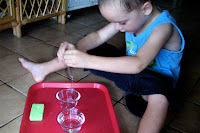
Today I introduced two new activities ("threading" toothpicks, bottles and tops) and we revisited pouring. During the course of each school session, we will revisit at least one activity presented on a prior day. The materials from previous days' activities sit on the school shelves (those ones I dragged out of the closet) and Parker gets to choose what he wants to work with. His freedom to choose allows him to become accustomed to taking the initiative with regards to his learning. And, at the risk of sounding like a broken record, one of the main aims of the Montessori method is to engender a sense of--altogether now!--independence in children. Parker wanted to revisit pouring this morning, which I took as a sign that my insane interference during school yesterday didn't permanently deter him from this whole learning thing. With his mother muzzled (figuratively, at least), he did really well pouring rice and after ten minutes or so asked, "Can I pour water now?" He did OK pouring water from the pitcher into the cups; pouring water out of the cups back into the pitcher posed more of a challenge. His spills enabled him to practice using a sponge, a skill he took to with seemingly instinctive ease (which is not at all shocking since he sees his mother scrubbing away with a sponge day in and day out). I did have to explain to him that the sponge needs to be wrung out occasionally; squeezing water out of sponges is now his new favorite pastime. He got a little overzealous emptying the cups, shaking them vigorously in an attempt to get every last drop of water out. Wet porcelain (er, glazed ceramic) can get pretty slick and a cup slipped out of his hands and broke. And now my son knows the meaning of the phrase, "handle with care!"


Postscript: Just in case you're wondering, when the cup broke, I remained calm, using the opportunity to explain to Parker why we need to be careful with certain types of things (e.g., ceramic cups, glasses, iPhones)--namely, they break. We bought the 12-item set of cups and saucers at Cost-U-Less (the Caribbean Costco) on St. Thomas for $9.99. I was not exactly crushed to see one cup become a casualty of school.